Harrisburg Real Estate Forecast 2027: Will Home Prices Continue to Rise?
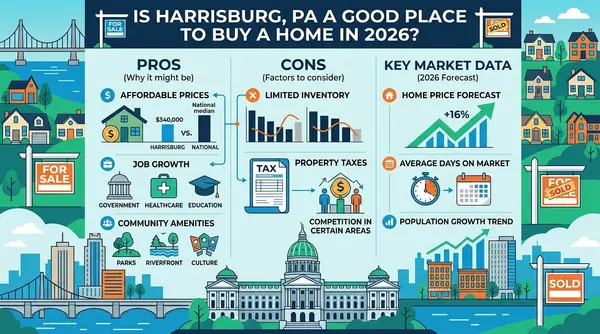
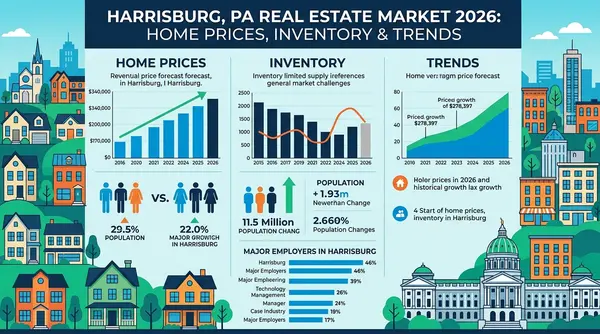
As Harrisburg moves toward 2027, one of the biggest questions for homeowners, buyers, sellers, and investors is what will happen to home prices.
After several years of changing mortgage rates, limited inventory, shifting buyer preferences, and rising housing costs, the next stage of the market could look different from the rapid-growth periods of the past.
At Onest Real Estate, we expect Harrisburg home prices to remain supported by underlying demand, but we also believe price growth will become increasingly dependent on local conditions.
The question may not simply be whether prices go up or down.
More importantly, buyers and sellers will need to understand where prices are rising, which properties are attracting demand, and why certain homes are performing better than others.
What Could Support Harrisburg Home Prices in 2027?
Several factors could provide support for property values across the Harrisburg area.
The first is affordability.
Compared with many larger U.S. metropolitan markets, Harrisburg can offer buyers a relatively accessible entry point into homeownership.
That can attract households who are looking for a balance between housing costs, employment opportunities, and quality of life.
Limited Inventory Could Keep Prices Firm
Housing supply will remain one of the most important factors influencing prices.
If there are not enough homes available for the number of buyers looking, competition can keep prices elevated.
This is especially true for properties that are:
-
Properly priced
-
Well maintained
-
Located in desirable communities
-
Move-in ready
-
Suitable for first-time buyers
Limited inventory does not necessarily cause prices to rise rapidly, but it can prevent significant declines when demand remains stable.
Mortgage Rates Could Change the Price Equation
Mortgage rates could have a major influence on Harrisburg home prices in 2027.
If rates decline, buyers could gain additional purchasing power.
However, lower rates could also bring more buyers into the market.
That creates a potential chain reaction:
Lower rates → more buyers → increased demand → greater competition → stronger prices.
This means falling mortgage rates do not automatically mean cheaper homes.
What If Mortgage Rates Stay High?
If borrowing costs remain elevated, buyers may become more price-conscious.
Some households could postpone purchasing.
Others could reduce their budgets.
This could slow price growth.
However, limited inventory could continue providing support to the market.
Affordability Could Be More Important Than Appreciation
For many buyers, the question will not be:
“Will this house appreciate 10%?”
Instead, it may be:
“Can I comfortably afford this home today?”
That shift could encourage more cautious purchasing decisions.
Buyers may prioritize predictable monthly costs over speculative future gains.
First-Time Buyers Could Influence Entry-Level Prices
First-time buyers are particularly important to the lower and middle portions of the market.
If financing conditions improve, demand for starter homes could increase.
This could put upward pressure on prices for:
-
Smaller single-family homes
-
Townhomes
-
Condos
-
Affordable suburban properties
Starter Homes May Remain Competitive
Affordable homes can attract a broad range of buyers.
A property priced below the regional median may receive attention from first-time buyers, downsizers, investors, and households relocating to Harrisburg.
That broad demand can help support values.
Move-In-Ready Homes Could Command a Premium
Buyers may be increasingly cautious about taking on major renovation projects.
High construction and labor costs can make renovations expensive.
As a result, a well-maintained home that requires little immediate work could sell more quickly than a similar property requiring extensive updates.
Renovated Does Not Automatically Mean More Valuable
Homeowners should also be careful about over-improving.
A $60,000 renovation does not guarantee a $60,000 increase in market value.
The improvement must make sense for the neighborhood and buyer expectations.
Location Will Continue to Drive Price Differences
Harrisburg's housing market is not uniform.
Prices can vary considerably between neighborhoods and surrounding communities.
Factors such as:
-
Schools
-
Transportation
-
Employment access
-
Shopping
-
Parks
-
Housing quality
-
Neighborhood character
can all influence property values.
Suburban Demand Could Support Prices
Some buyers may continue looking outside Harrisburg for larger homes and additional space.
Communities that combine suburban amenities with convenient access to Harrisburg could remain attractive.
Remote Work Could Expand Buyers' Options
Hybrid workers may be less dependent on living immediately near their workplace.
This can expand the number of communities they consider.
A buyer may be willing to live farther away if they only commute a few days per week.
But Commute Costs Still Matter
A lower home price does not necessarily mean lower overall living costs.
Longer commutes can increase:
-
Fuel expenses
-
Vehicle maintenance
-
Travel time
-
Transportation stress
Buyers should evaluate the complete lifestyle cost.
Property Taxes Can Affect Market Value
Taxes are an important component of homeownership costs.
Buyers comparing similar homes should look at the annual property tax burden.
A lower-priced property with significantly higher taxes may not actually provide better affordability.
Insurance Costs Could Become More Important
Homeowners also need to consider insurance.
Changes in insurance premiums can affect affordability and the overall cost of ownership.
This could influence the price buyers are willing to pay.
New Construction Could Add Competition
New homes can provide additional inventory.
Buyers may appreciate:
-
Modern layouts
-
Energy-efficient systems
-
New appliances
-
Contemporary finishes
-
Lower immediate maintenance needs
Existing homes may need to compete by offering better locations, larger lots, character, or lower prices.
Existing Homes Still Have Strong Advantages
Harrisburg's established neighborhoods can provide features that new construction cannot easily reproduce.
These may include:
-
Mature trees
-
Established streets
-
Larger lots
-
Unique architecture
-
Convenient locations
-
Existing community amenities
This can help older properties maintain buyer appeal.
Investor Demand Could Affect Affordable Properties
Investors may continue looking for reasonably priced homes with strong rental potential.
If investor demand remains active, competition could support prices for certain properties.
However, investors will increasingly need to account for financing, taxes, maintenance, insurance, and vacancy.
Rental Demand Could Support Property Values
A strong rental market can make investment properties more attractive.
If rental demand remains healthy, investors may continue purchasing properties that provide reasonable long-term rental potential.
Economic Conditions Will Matter
Housing markets do not operate independently from the economy.
Employment levels, wage growth, consumer confidence, and business activity can all influence housing demand.
A strong local economy generally provides a stronger foundation for housing demand.
Employment Diversity Could Help Harrisburg
Harrisburg benefits from employment connected to government, healthcare, education, logistics, retail, professional services, and other sectors.
A diverse employment base can provide stability when one industry experiences weakness.
Population and Household Growth Could Influence Demand
Housing demand is ultimately connected to the number of households seeking homes.
If the Harrisburg region continues attracting residents and forming new households, additional housing demand could support prices.
What Could Cause Prices to Decline?
A significant decline would likely require a combination of negative factors.
Potential pressure could come from:
-
Rising unemployment
-
Significant inventory growth
-
Persistently high mortgage rates
-
Weak buyer demand
-
Falling consumer confidence
-
Increasing ownership costs
One factor alone may not be enough to produce a major correction.
A Market Correction Is Different From a Crash
A slower market does not automatically mean a housing crash.
Prices can stabilize or experience modest adjustments without experiencing a dramatic collapse.
This distinction is important for homeowners and buyers.
Price Growth Could Become More Moderate
Rather than expecting dramatic annual appreciation, buyers and sellers may need to prepare for more measured price movement.
This could create a healthier environment where property values are supported by fundamentals rather than rapid speculation.
Sellers Should Not Assume Last Year's Price Is This Year's Price
Homeowners often look at what a nearby property sold for and assume their home should command the same price.
But market conditions change.
Differences in:
-
Condition
-
Size
-
Location
-
Updates
-
Lot
-
Layout
can create substantial differences in value.
Accurate Pricing Will Become More Important
In a balanced market, overpriced homes can remain on the market longer.
Longer marketing periods can lead to price reductions.
Sellers may therefore benefit from realistic pricing from the beginning.
Buyers Should Avoid Waiting for a “Perfect” Price
Predicting the exact bottom or top of the housing market is extremely difficult.
A buyer who waits for a major price decline may discover that mortgage rates or inventory conditions have changed in the meantime.
The best time to buy is generally connected to personal financial readiness rather than market predictions alone.
Monthly Payment Should Guide the Decision
A buyer should determine what payment they can comfortably manage.
That includes:
-
Mortgage
-
Taxes
-
Insurance
-
Maintenance
-
Utilities
-
HOA costs
A property that fits within a sustainable budget can be more important than trying to predict future appreciation.
What Onest Real Estate Expects for 2027
At Onest Real Estate, we expect Harrisburg home prices to remain relatively resilient in 2027, particularly in areas with strong demand and limited inventory.
We do not expect every property to perform equally.
Well-priced homes in desirable locations could remain competitive.
Properties that are overpriced or require significant work may take longer to sell.
The Market Could Become More Neighborhood-Specific
One of the most important trends to watch is increasing separation between different parts of the market.
One neighborhood may experience strong demand while another remains relatively quiet.
One price range may have limited inventory while another has more available homes.
This means local analysis will become increasingly important.
Sellers Should Focus on Value
The strongest sellers in 2027 may be those who understand what buyers are actually willing to pay.
That means:
-
Preparing the property properly
-
Pricing competitively
-
Highlighting useful features
-
Addressing obvious maintenance problems
-
Being realistic about market conditions
Buyers Should Focus on Opportunity
A changing market can create opportunities.
Buyers may have more negotiating power on properties that have been sitting on the market.
They may also have opportunities to purchase homes that previously attracted intense competition.
Investors Should Look Beyond Appreciation
Real estate investors should not depend entirely on future price growth.
A property should make sense based on its current fundamentals.
Rental income, expenses, financing, vacancy, maintenance, and potential long-term demand should all be considered.
Looking Toward 2030
Over the longer term, Harrisburg home prices will likely be influenced by:
-
Housing supply
-
Employment
-
Population changes
-
Infrastructure
-
Interest rates
-
Construction costs
-
Household income
-
Neighborhood development
These factors can create different outcomes across the region.
The Future May Favor Sustainable Growth
A market built around sustainable demand is healthier than one driven entirely by speculation.
Harrisburg's affordability and economic role can provide a foundation for long-term housing demand.
But future growth will depend on how supply and demand evolve.
Final Thoughts
Will Harrisburg home prices continue to rise in 2027?
They could, particularly in neighborhoods where demand remains strong and inventory remains limited.
But buyers and sellers should not expect every property to experience the same level of appreciation.
At Onest Real Estate, we believe the Harrisburg market is likely to become increasingly focused on value, affordability, property condition, and location.
For buyers, the goal should be finding a home that fits comfortably within their financial situation.
For sellers, accurate pricing and preparation will be essential.
For investors, long-term fundamentals should matter more than short-term speculation.
The Harrisburg real estate market of 2027 may not be defined by dramatic price increases.
Instead, it could be defined by a more measured market where well-located, well-priced, and well-maintained properties continue to stand out.
Categories
Recent Posts